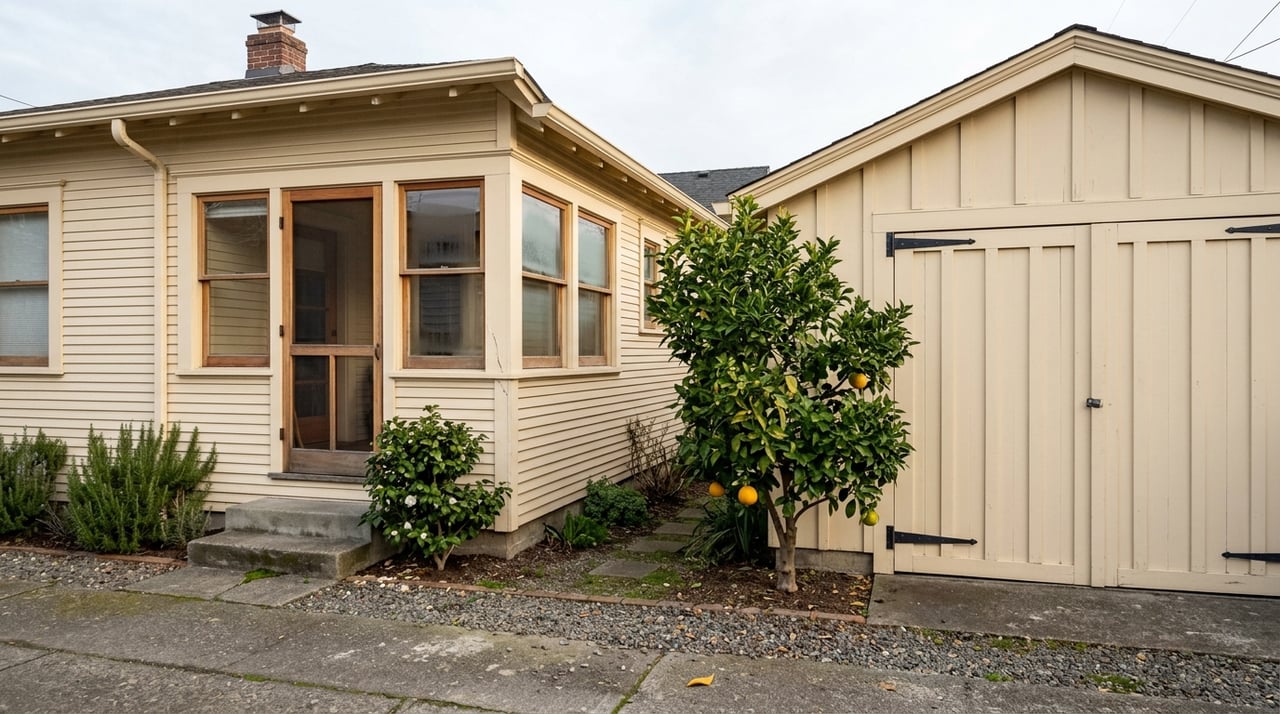
A "single-family home" in North Park no longer guarantees what the label implies. Since August 22, 2025, the City of San Diego has allowed a permitted accessory dwelling unit to be split off from the main house and sold as its own condominium, complete with a separate deed and its own Assessor's Parcel Number. The lot itself doesn't divide. The ownership does.
That distinction sounds like a technicality until you're the buyer standing in escrow. A property that reads as one home on the MLS can already be structured, or mid-structured, as two legally separate units under recorded CC&Rs. That changes how a lender evaluates the loan, how an appraiser treats the comps, and what a seller can and can't promise about what you're actually purchasing. In a neighborhood where the City of San Diego issued 117 ADU permits over the past 12 months alone, on top of another 117 permits for single-family and duplex renovations, this isn't a corner case. It's a live condition on blocks buyers are touring right now.
What Changed, and Why the Date Matters
California's AB 1033, passed in 2023, is an opt-in law. It doesn't do anything on its own. Each city and county has to adopt its own ordinance before AB 1033 applies locally, and each writes its own rules for how the process works. San Diego was one of the first cities in the county to opt in, doing so through Zoning Ordinance Update O-21989, effective August 22, 2025. The City's ADU information bulletin lays out the mechanics: a new or existing ADU can be subdivided into a condominium and conveyed separately from the primary residence, provided the unit has cleared final inspection, carries no active affordability covenant, and every lender with a lien on the property has signed off in writing.
San Diego County followed on a different timeline. The Board of Supervisors adopted its own version of the ordinance on March 4, 2026, with the rule taking effect April 4, 2026, but only for unincorporated areas. North Park sits inside city limits, so the August 2025 date is the one that governs there. That gap between city and county timing matters if you're comparing North Park to a similar-looking lot in an unincorporated pocket of the county. They are not playing by the same rulebook yet, and the County's own project page confirms the separate adoption path.
Why North Park Feels This First
Coastal properties in La Jolla or Del Mar face an extra layer that inland North Park doesn't: any ADU regulation change has to clear California Coastal Commission certification before it applies inside the Coastal Overlay Zone. That certification process has historically added months, sometimes longer, to timelines for coastal ADU projects. North Park carries no such overlay. A condo-mapping application here moves through the standard Development Services Department track without waiting on a state coastal agency to sign off on the underlying zoning change.
Combine that procedural head start with the sheer volume of ADU activity already happening in the neighborhood, and North Park becomes the place in the Higgins Group's coverage area where this mechanism is most likely to show up in an actual transaction rather than stay a hypothetical.
The Permit Numbers Are the Tell
Over the past 12 months, the City of San Diego issued more than 500 development permits in the North Park community planning area. The breakdown matters more than the total: 126 permits for new apartment buildings of five or more units, 117 for accessory dwelling units, another 117 for renovations to existing single-family and duplex properties, and 75 for tenant improvements to commercial space. Roughly one in four of those permits went specifically toward adding a new backyard unit, on top of an equal number for renovations to existing homes. Many of those ADU permits are landing on the same alley-accessed lots near 30th Street and Upas Street that already have detached garages, exactly the setup that makes a backyard conversion straightforward.
For a buyer, that permit density means the odds of encountering a listing with an existing or plausible ADU are meaningfully higher in North Park than in a neighborhood with a flatter permit history. It also means the pool of properties eligible for condo-mapping down the road, whether the current owner pursues it or a future one does, is larger than most buyers assume when they're scrolling listing photos.
What Separates a Standard Listing From a Mappable One
| Standard North Park single-family listing | Listing with a condo-mappable ADU | |
|---|---|---|
| What's on the deed | One parcel, one owner | One parcel, potential for two condominium units under future CC&Rs |
| Lender treatment | Standard single-family underwriting | May require lienholder consent before any future subdivision |
| Utility setup | Shared meters typical | Separate water, sewer, gas, and electric metering required for mapping |
| Exit flexibility for a future owner | Sell the whole property | Option to sell main house and ADU separately, subject to a 30-day owner-occupant marketing requirement on the ADU |
| Appraisal complexity | Comparable to nearby single-family sales | May need comps that account for the ADU's standalone sale potential, which are still thin in this market |
That last row is where the friction shows up fastest. Appraisers rely on recent comparable sales, and condo-mapped ADU sales are new enough in San Diego that clean comps barely exist yet. A property with a mapped or mappable ADU may look identical to a conventional single-family home in every listing photo and still require a different conversation with your lender about how the appraisal will be handled.
What Condo-Mapping Actually Requires
If you're evaluating a North Park property with an existing ADU and wondering whether a future owner, or you, could eventually sell it separately, the process the City lays out has several sequential steps:
- Confirm the ADU has final approval on all inspections tied to its original building permit.
- Verify there's no active deed restriction or affordability covenant attached to the unit, since ADUs financed with San Diego Housing Commission assistance or rent-restricted to specific income levels cannot be split off for the life of that restriction.
- Prepare a tentative parcel map and a Condominium Plan through a licensed surveyor or engineer.
- Obtain written consent from every lienholder on the property before any map or plan is recorded.
- Install separate utility meters for water, sewer, gas, and electricity if they aren't already independent.
- Record a covenant requiring the ADU to be listed for at least 30 days on at least two public real estate platforms, with a disclosure that priority goes to buyers who intend to live in it as their primary residence.
- Submit the completed package to Development Services for review and, once approved, record the final Condominium Map.
None of this happens overnight. Industry estimates for a full conversion in unincorporated areas of the county run two to three years, and there's no reason to expect the city process moves dramatically faster given the same lienholder consent and mapping requirements apply.
The Parking Math Nobody Puts in the Listing
There's a second friction compounding all of this, and it has nothing to do with condo law. California's daylighting law, AB 413, made it illegal starting January 1, 2025 to park within 20 feet of any crosswalk, marked or unmarked, even where there's no red curb or sign. San Diego began enforcing it on March 1, 2025, and North Park was the city's most-ticketed neighborhood in the early months, so much so that residents started calling it "No Park." A CBS 8 investigation tracking the citywide rollout found the law hit the neighborhood's already tight curb space hardest before enforcement attention shifted to other parts of the city.
Every additional ADU or condo-mapped unit adds a household's worth of potential parking demand to a street that was already losing legal spots to the 20-foot buffer rule. A garage, a driveway, or off-street parking on a North Park lot is no longer just a convenience feature. It's protection against a specific, dated, ongoing enforcement reality that a square footage number will never capture.
What to Check Before You Write an Offer
- Ask whether any ADU on the property has final permit sign-off, not just a permit application on file.
- Ask the seller's agent directly whether condo-mapping has been started, discussed, or ruled out.
- If there's an existing mortgage on the property, ask whether the lender has been consulted about future subdivision, since consent from every lienholder is required before any mapping can proceed.
- Confirm whether utilities are already separately metered or would need to be split.
- Walk the block at different times of day to see how tight parking actually is, not just how the listing photos frame the curb.
FAQ
Does every ADU in North Park qualify for separate sale? No. ADUs financed with San Diego Housing Commission assistance or subject to a rent restriction covering very low, low, or moderate income tenants cannot be subdivided and sold separately for as long as that covenant remains in effect.
Does this apply if I'm looking outside city limits, closer to unincorporated pockets near North Park? Not on the same timeline. The county's version of the ordinance didn't take effect until April 4, 2026, months after the city's August 2025 start date, and it applies only to unincorporated areas.
Does having a mappable ADU automatically make a property worth more? Not automatically. It adds a future option, not a guaranteed premium. The value depends on whether the eventual buyer for the ADU unit wants to live in it, since the law requires a 30-day owner-occupant marketing window, and on how appraisers eventually price a still-thin set of comparable sales.
North Park's permit numbers, its position outside the Coastal Overlay Zone, and its head start on parking enforcement all point to the same conclusion: the mechanics of what you're buying here are shifting faster than most listing descriptions can keep up with. If you're comparing a North Park address against South Park, University Heights, or a North County alternative, the questions above are the ones that actually separate one asset from another.
If you want a second set of eyes on a specific North Park listing, or you're trying to figure out what an existing ADU on a property you already own could be worth under these new rules, the Higgins Group can walk through the permit history and the numbers with you. Request a Complimentary Home Valuation to start that conversation.