As Hoodline reported, "If you're an MCM design buff, this is a must-see," said Barry Hager, advisory director and co-founder of Mission Hills Heritage. He's talking about a home tour that has run for eighteen years without ever saying that sentence before.
On Saturday, September 26, Mission Hills Heritage will hold its 19th Annual Historic Home Tour, and for the first time in the event's history, the theme is midcentury-modern architecture and nothing else. Not Spanish Revival, not Craftsman bungalows, not the "Master Builders" showcase of years past. Just the low-slung, glass-fronted, canyon-hugging houses that most people driving through Mission Hills never notice because they're not the houses this neighborhood is known for.
That's the part worth sitting with. Mission Hills has a reputation, and it's a red-tile-roof, wrought-iron, 1920s-streetcar-suburb reputation. Two city-designated historic districts protect that identity on paper. Neither one covers the houses opening their doors this weekend.
The Districts Were Drawn Around a Different Decade
Mission Hills started as a real estate play in 1908, when a development company partnered with civic figure George Marston to subdivide the mesa above Old Town. An electric streetcar line reached the area in 1910, and the lots along the flatter ridgelines filled in fast with the Craftsman foursquares and Spanish Eclectic homes that still define most postcard images of the neighborhood.
In 2007, the City of San Diego made that history official, designating two adjacent historic districts, the Mission Hills Historic District and the Fort Stockton Line Historic District, covering 174 homes built in the early twentieth century. The designation followed a grassroots nomination pushed by residents who wanted their streets protected as a set, not just as individual houses.
That's the piece a lot of longtime residents don't clock: those districts have a build date built into their boundaries. They protect what went up before roughly 1930. They say nothing about what came thirty years later, when a different generation of architects looked at the same neighborhood and saw something the first developers had skipped over.
Why the Canyon Rims Got the Second Wave
The flat mesa tops were the easy lots. Cheaper to grade, cheaper to build on, cheaper to plumb. The canyon rims that drop off toward Mission Valley and the Presidio were the leftover parcels, too steep and too expensive for a 1910s subdivision to bother with.
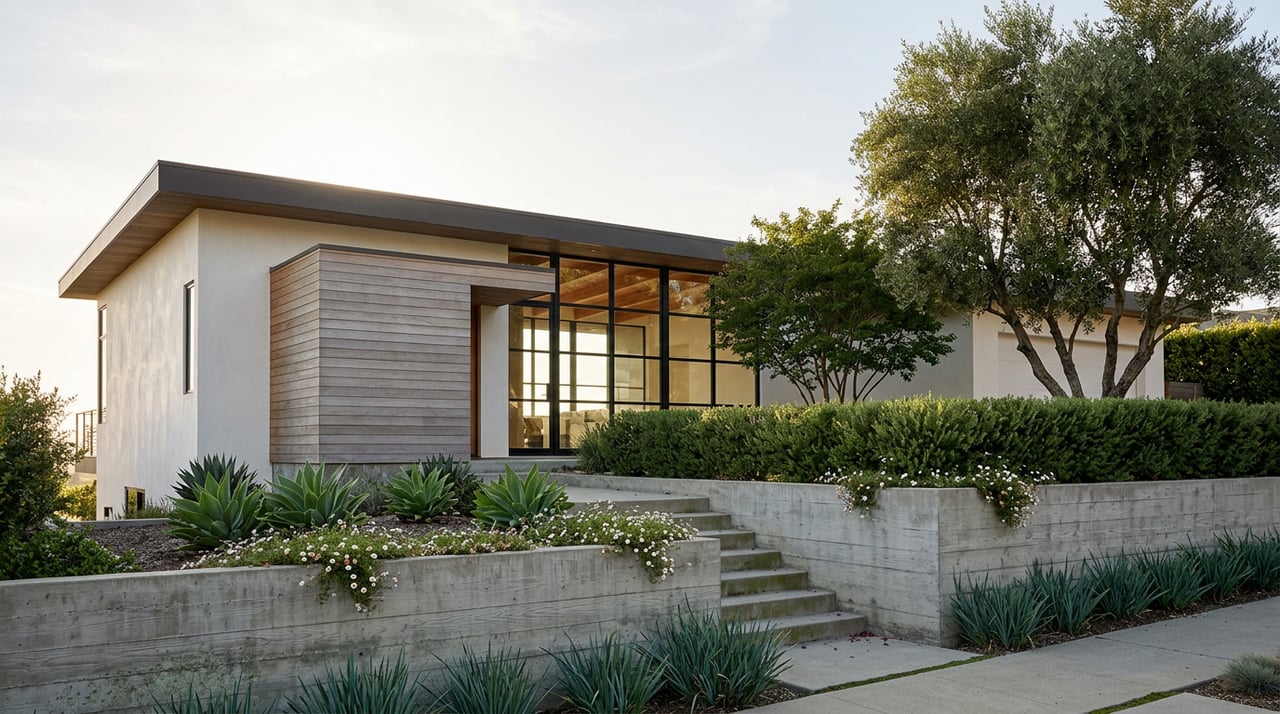
By the 1950s that liability had become the point. Architects including Lloyd Ruocco, Frederick Liebhardt, and Homer Delawie started building homes along those same canyon edges, and instead of fighting the slope, they used it, stepping floor plans down the hillside and running glass walls toward the canyon views the flatland lots never had. The result is a concentration of midcentury-modern residences that ranks among the largest in the region, built with the clean lines and indoor-outdoor massing the style is known for, and sitting almost entirely outside the boundaries of either 2007 historic district.
Individual recognition has happened here and there. The city designated the Cliff May House as a historic resource back in 2014, which shows that this architecture has always had defenders. But landmarking one house at a time is a different thing than a neighborhood-wide tour that says these homes belong in the same conversation as the bungalows down the hill. That's what changes on the 26th.
What's Actually Open This Year
This year's headline stop is the Robertson House, a Lloyd Ruocco design that has never been open to the public in the tour's nineteen-year run. It's owned by a local school now, which is part of why it stayed closed for so long, and part of what makes Saturday notable. Inside, visitors will find paintings by San Diego modernist Richard Marks alongside a midcentury furniture exhibit, with refreshments offered on site.
The tour is self-guided, running 10 a.m. to 4 p.m., starting from Mission Hills United Methodist Church, where visitors pick up wristbands for staggered entry into each home. Tickets run $50 for Mission Hills Heritage members and $60 for nonmembers, and organizers have flagged that some entry slots are already sold out, so early purchase is the safer move if you want a specific window.
Alongside the houses, Classic Thunderbirds of San Diego, Chapter 24, will display several Thunderbird automobiles from the 1950s along the route, which is a small touch but not a random one. Pairing midcentury cars with midcentury architecture is the kind of detail that tells you the organizers are thinking about the whole era, not just the buildings.
This didn't come out of nowhere. Mission Hills Heritage opened 2026 with a two-day Mid-Century Modern Weekend back in May, including a Modernism Mixer reception and lectures from architectural historians Keith York and Dave Hampton. Read the two events together and the pattern is clear: this is the year the organization decided to give its modernist houses a season, not just a Saturday.
Worth the Saturday
None of this requires you to be in the market for anything. The tour is a walk through houses most Mission Hills residents pass without a second look, guided by the people who've spent years arguing that those houses deserve one. Whether you end up standing in the Robertson House thinking about Ruocco's floor plan or just admiring a '57 Thunderbird parked at the curb, it's a rare chance to see inside a layer of this neighborhood that the official record has mostly left out.
And if the tour leaves you newly curious about what a well-kept midcentury property on a canyon lot is actually worth in today's market, or how a house like that gets positioned when it does eventually change hands, that's a conversation Josh Higgins is glad to have. Request a complimentary home valuation whenever you're ready to talk specifics, no tour ticket required.